Downloadable Land Management Plan Template (with Examples)
Download a free, customizable 5-Year Land Management Plan template. Perfect for organizing goals, applying for USDA EQIP funding, and securing property tax exemptions.
Downloadable Land Management Plan Template (with Examples)
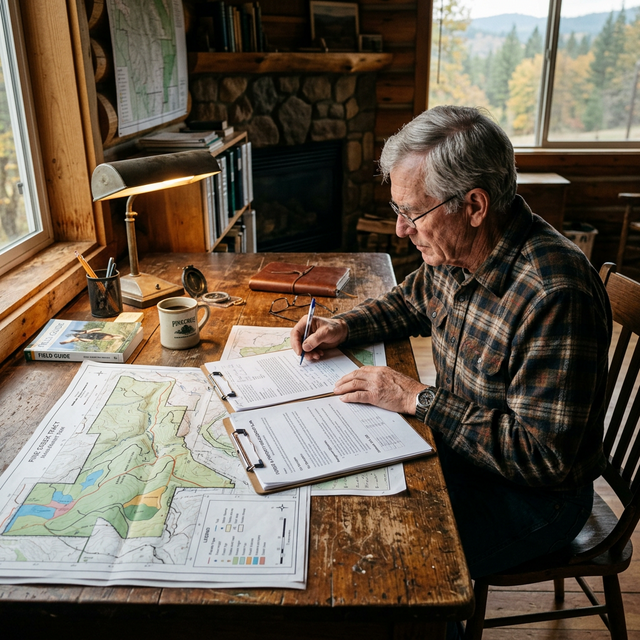
If you have read our core guide on How to Create a Simple 5-Year Land Management Plan, you know that a written plan is the single most important document a landowner can possess.
A formal plan does three things:
- It stops you from making expensive, impulsive mistakes (like buying cattle before you have secure fencing).
- It is the absolute prerequisite for securing federal cost-share funding through programs like EQIP.
- It provides the legal documentation demanded by county tax assessors to maintain highly lucrative Ag or Timber property tax exemptions.
To make the process as frictionless as possible, we have created a comprehensive, fill-in-the-blank template based on the exact structure preferred by USDA Natural Resources Conservation Service (NRCS) planners and state forestry agencies.
How to Use This Template
The template is broken into five core sections. You do not need to fill out every single line—only the sections relevant to your specific property goals (e.g., if you don't own timber, delete the Forestry section).
The Goal: Treat this as a "living document." Print it out, put it in a 3-ring binder alongside your property maps and soil test results, and update it every winter.
(Below is the plain-text version of the template. Copy and paste it into your preferred word processor, such as Microsoft Word or Google Docs.)
đźšś LandHelp.info: 5-Year Property Management Plan
Property Name: [e.g., Whispering Pines Farm] Landowner(s): [Your Name(s)] Total Acreage: [e.g., 45 Acres] County & State: [e.g., Boone County, Missouri] Date Plan Established: [Date] Prepared By: [Your Name or Consulting Forester/Biologist Name]
SECTION 1: OVERARCHING VISION & GOALS
Briefly describe your ultimate 10-to-20 year vision for the property. What is the primary purpose of this land? (Rank your top 3 goals below).
The Vision Statement: [e.g., "To operate a financially sustainable, regenerative rotational grazing farm while maximizing upland bird habitat and maintaining lower agricultural property tax valuation."]
Primary Goals (Ranked in order of priority):
- [e.g., Improve pasture soil health and eliminate synthetic fertilizer use.]
- [e.g., Eradicate invasive Autumn Olive on the southern 10 acres.]
- [e.g., Establish a profitable hunting lease to cover annual property taxes.]
SECTION 2: RESOURCE INVENTORY (What do I have right now?)
Detail the current state of the property. Attach aerial maps utilizing free mapping tools to this section.
2A. Infrastructure Assets
- Fences: [e.g., 2,000 ft of 5-strand barb wire on perimeter (poor condition). No interior cross fencing.]
- Water Sources: [e.g., One 1-acre surface pond. One deep well at the farmhouse.]
- Structures: [e.g., One 30x40 pole barn. Main residence.]
- Access Roads: [e.g., Good gravel driveway. Dirt logging roads present but heavily rutted.]
2B. Pasture & Cropland
- Acreage: [e.g., 20 Acres]
- Current Forage Species: [e.g., Dominated by Kentucky 31 Tall Fescue with heavy weed pressure (ironweed, thistle).]
- Current Soil Health: [e.g., Last soil test (Oct 2025) showed acidic pH 5.4 and low Organic Matter (1.5%).]
2C. Forestry & Wildlife Habitat
- Acreage: [e.g., 25 Acres]
- Timber Type: [e.g., Mixed upland hardwood (mostly white oak and hickory). Roughly 40 years old, highly overcrowded.]
- Invasive Species Present: [e.g., Heavy Bush Honeysuckle in the understory suppressing oak regeneration.]
- Target Wildlife Species: [e.g., White-tailed deer and wild turkey.]
SECTION 3: MANAGEMENT PRESCRIPTIONS (What am I going to do?)
This is the action plan. Break down the specific practices required to achieve the goals set in Section 1.
3A. Soils & Forage Improvement
- Practice 1: Apply 2 tons of agricultural lime per acre to the 20-acre pasture to correct pH balance by Spring 2026.
- Practice 2: Rent a no-till drill to interseed crimson clover and tillage radish into the fescue to improve soil health naturally.
- Practice 3: Transition from continuous grazing to a rotational grazing system to increase rest periods for the grass.
3B. Infrastructure Improvements
- Practice 1: Construct 1,500 feet of high-tensile interior cross-fencing to establish 4 separate grazing paddocks.
- Practice 2: Install a solar water pump on the main well to gravity-feed designated water troughs in the new paddocks, keeping cattle out of the pond.
3C. Forest & Wildlife Management
- Practice 1: Conduct Crop Tree Release (thinning) on the 25-acre timber stand, prioritizing the release of mature white oaks to increase acorn mast for deer.
- Practice 2: Implement a "hack-and-squirt" herbicide program in late summer to eradicate the invasive Bush Honeysuckle.
- Practice 3: Build 5 large brush piles and retain standing snags along the pasture edge for small mammal cover.
SECTION 4: THE 5-YEAR TIMELINE (When am I doing it?)
Assign the prescriptions from Section 3 to specific years. Do not try to do everything in Year 1.
YEAR 1 (2026): The Baseline Year
- Apply agricultural lime to pasture based on soil test results.
- Begin invasive species removal (Hack-and-squirt honeysuckle).
- Apply to USDA NRCS for EQIP cost-share funding for cross-fencing.
YEAR 2 (2027): Infrastructure Construction
- Construct the interior high-tensile cross-fencing (pending EQIP approval).
- Erect solar water pump and lay buried water lines to paddocks.
- Begin rotational grazing (moving cattle every 3 days).
YEAR 3 (2028): Habitat & Soil Focus
- No-till drill multi-species cover crops into pastures during late summer.
- Complete Crop Tree Release (thinning) on the first 10 acres of timber.
- Build edge-feathering brush piles along the timber/pasture transition zone.
YEAR 4 (2029): Expansion
- Complete Crop Tree Release on the remaining 15 acres of timber.
- Interseed native warm-season grasses (NWSG) into the weakest pasture paddock.
- Pull new soil tests to monitor Organic Matter and pH changes.
YEAR 5 (2030): Review & Reassess
- Evaluate the success of the rotational grazing program (did forage density increase?).
- Meet with local tax assessor to renew Agricultural/Wildlife valuation based on completed work.
- Draft the next 5-year plan.
SECTION 5: FINANCIAL & BUDGETING ESTIMATES
Estimate the out-of-pocket costs and potential cost-share funding for major projects over the 5-year life of the plan.
| Project | Estimated Total Cost | Potential Funding Source | Expected Out-of-Pocket |
|---|---|---|---|
| Ag Lime Application (20 acres) | $1,200 | Operations Budget | $1,200 |
| Cross-Fencing (1,500 ft) | $3,500 | USDA EQIP (Practice 382) | $875 (25%) |
| Solar Water System & Troughs | $4,200 | USDA EQIP (Practice 516/614) | $1,050 (25%) |
| Timber Thinning (Labor) | $2,000 | USDA EQIP (Practice 666) | $500 (25%) |
| No-Till Drill Rental & Seed | $800 | Operations Budget | $800 |
| TOTALS: | $11,700 | $7,275 (Cost-Share) | $4,425 |
(Note: EQIP rates vary heavily by state and applicant status. Always verify current payment schedules with your local NRCS office).
(End of Template)
Summary
A downloaded template is useless if you don't execute it. Use this document as the framework to get your massive, overwhelming to-do list out of your head and onto paper. Break the massive tasks (like "build perimeter fence") down into single-year bite-sized chunks, lean heavily on the technical and financial support of your local USDA service center, and methodically turn your vision into reality.
Explore more: Once your plan is drafted, start mapping out the specific paddocks and timber stands detailed in Section 2 using our guide to Free Property Mapping Tools.
Written by Dr. Sarah Mitchell, Senior Editor & Land Management Specialist at LandHelp.info. Dr. Mitchell has authored hundreds of comprehensive conservation plans for private landowners worldwide, specializing in integrating agricultural production with wildlife habitat improvement.
Tags:
Dr. Sarah Mitchell
Senior Editor & Land Management Specialist
Dr. Mitchell has over 20 years of experience in natural resource management, with expertise in sustainable agriculture and forest stewardship. She holds a Ph.D. in Natural Resource Management from Colorado State University and has worked with the USDA NRCS for 15 years.