Free Soil Testing Guide: How and Where to Get Your Soil Tested
A complete guide to soil testing for rural landowners. Learn how to take an accurate sample, where to send it for free or low-cost analysis, and how to read the results.
Free Soil Testing Guide: How and Where to Get Your Soil Tested
If you own land—whether it's a half-acre vegetable garden, a 10-acre horse pasture, or a 50-acre food plot—managing it without a soil test is equivalent to driving cross-country blindfolded.
Every year, landowners waste thousands of dollars applying the wrong fertilizer or spreading lime they don't need purely because "that's what the guy at the feed store recommended." Applying nitrogen to a pasture that actually needs phosphorus is burning money and polluting the local watershed.
A professional soil test gives you the exact baseline chemistry of your dirt. It tells you your pH, your organic matter percentage, and exactly how many pounds of nutrients you need to apply to achieve your yield goals. Best of all, through your state's Cooperative Extension network, these tests are highly subsidized and sometimes 100% free.
Here is how to take an accurate sample, where to send it, and how to decode the dizzying lab report.
1. How to Take an Accurate Soil Sample
The laboratory can only analyze the dirt you send them. If you take a bad sample, you get bad data.
A "soil sample" is not just a single scoop of dirt from one spot in the field. It must be a composite sample representing the entire area.
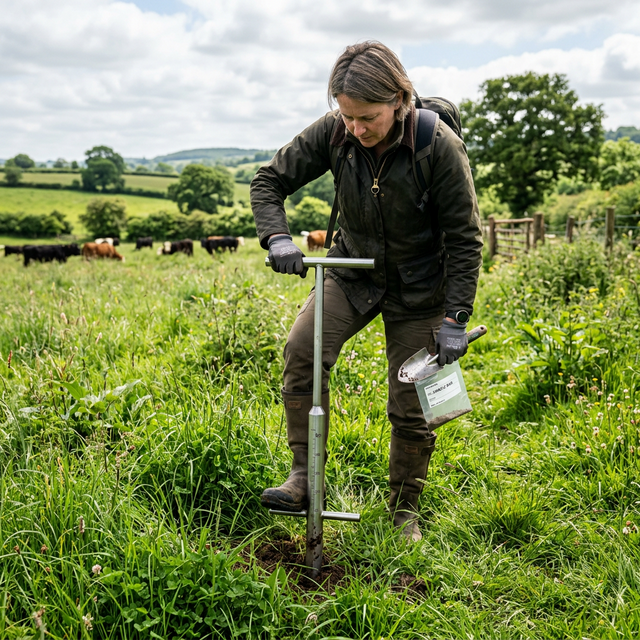
The Tools You Need
- A clean plastic bucket (do NOT use a galvanized metal bucket; the zinc will contaminate the test).
- A soil probe or a clean garden trowel/spade.
- A soil sample box or heavy-duty Ziploc bag.
The 4-Step Sampling Process
- Define the Zone: Do not mix soil from the front yard garden with soil from the back horse pasture. Treat them as two separate tests. If you have a 10-acre pasture, that is one "Zone."
- The Zig-Zag Walk: Walk across the Zone in a zig-zag "W" pattern. Stop 15 to 20 different times along the route.
- Pull the Cores: At each stop, clear away the surface grass/mulch. Dig a straight, vertical slice exactly 6 inches deep (if testing a pasture or garden) or 4 inches deep (if testing a lawn). Put that slice of dirt into your plastic bucket.
- Mix and Box: Once you have collected all 15-20 slices in the bucket, thoroughly mix the dirt together with your hands, breaking up clods and removing large rocks or roots. Scoop exactly 1 to 2 cups of this perfectly mixed soil into your sample box.
2. Where to Send It (The Cooperative Extension Secret)
Do not buy the cheap "At-Home pH Test Kits" from the hardware store with the little plastic color-changing vials. They are notoriously inaccurate and useless for large acreages.
You must use a professional agricultural laboratory.
Every state in the U.S. has a Land-Grant University that operates a Cooperative Extension Service. Their mandate is to provide scientific analysis to local citizens. They run massive, state-of-the-art soil labs.
How to Find Your Lab
Open Google and search: [Your State] Cooperative Extension Soil Testing.
(Example: "Texas A&M Cooperative Extension Soil Testing" or "Penn State Extension Soil Testing").
- The Cost: Many states (like Arkansas and North Carolina) offer standard soil testing for free to state residents for parts of the year, subsidized by the state department of agriculture. Other states charge a deeply discounted fee (usually between $8 and $15 per box).
- The Process: You can usually walk into your local County Extension Office (found in almost every county seat courthouse in America), pick up the official cardboard sample boxes and mailing forms for free, and mail them straight to the university lab.
3. How to Read the Soil Report (The Big Three)
Two weeks after mailing your box, you will receive an email containing a PDF report that looks like a high school chemistry exam. Don't panic. You only need to focus on three primary numbers to make immediate management decisions.
1. Soil pH (The Ultimate Gatekeeper)
If your pH is wrong, nothing else matters. The pH scale runs from 0 to 14 (7.0 is neutral). Most pasture grasses, clover, and garden vegetables thrive in a pH range of 6.0 to 6.8.
- If your soil is too acidic (e.g., pH 5.2), the soil physically "locks up" the fertilizer you apply. You could dump 100 lbs of nitrogen on the field, and the plant roots cannot absorb it.
- The Fix: The report will tell you exactly how many tons of agricultural lime to apply per acre to raise the pH to the optimal level. Always fix your pH before buying fertilizer.
2. Phosphorus (P) and Potassium (K)
These are two legs of the N-P-K fertilizer triad.
- If the report shows these levels as "Optimum" or "High," do not apply any more.
- If they are "Low," the report will give you a specific recommendation (e.g., "Apply 40 lbs of P2O5 per acre").
Note about Nitrogen (N): Most basic soil tests do not test for Nitrogen because it is highly volatile and washes out of the soil quickly with rain. Instead, the lab will automatically recommend a flat rate of Nitrogen based on the crop you told them you were growing on the submission form.
3. Organic Matter (OM) Percent
This is the holy grail number for regenerative agriculture and drought resilience. A terrible, depleted soil might be 1% OM. A rich, dark, drought-proof soil might be 4-5% OM. Keep this report in a folder, re-test every three years, and watch your OM slowly climb as you implement no-till and cover crop practices.
The "Grid Sampling" Upgrade for Precision Ag
If you are managing large acreages (50+ acres) or writing a 5-Year Land Management Plan for high-dollar crop production, standard composite sampling might not be accurate enough.
A 50-acre field does not have identical soil chemistry across the entire expanse. The bottom-land near the creek may be highly acidic, while the top of the ridge is perfectly balanced. If you take a composite sample of both, the lab averages it out, telling you to apply 1 ton of lime everywhere—which over-limes the ridge and under-limes the creek.
Grid Sampling solves this. You hire a precision ag company (or your local fertilizer co-op) to drive an ATV across the field, taking a separate GPS-tagged soil sample every 2.5 acres. They use this data to create a digital "heat map" of your field's chemistry. You load a thumb drive into the tractor spreader, and it automatically adjusts the fertilizer rate second-by-second as you drive across the field, putting the expensive materials only exactly where they are needed.
Summary
Soil testing is the highest return-on-investment activity a landowner can perform. For the cost of postage (or a $10 lab fee), you receive a scientific diagnosis that can literally save you thousands of dollars in wasted fertilizer and unlock the true yield potential of your pastures, food plots, and gardens. Pull a sample this fall, adjust your pH according to the lab's recommendations over the winter, and watch your property explode with growth next spring.
Explore more: Learn what to plant in your newly balanced soil by reading about Improving Soil Health with Cover Crops, or utilize the USDA EQIP program to help fund the lime applications your soil test recommends.
Sources & Further Reading
- USDA NRCS — Soils Information: nrcs.usda.gov
- University of Missouri Extension — Soil Testing and Plant Diagnostic Services: extension.missouri.edu
- Penn State Extension — Soil Testing FAQs: extension.psu.edu
- Understanding Ag — The Importance of Soil Testing: understandingag.com
- The Noble Research Institute — How to Take a Soil Sample: noble.org
Written by Tom Miller, Regenerative Agriculture & Homesteading Contributor at LandHelp.info. Tom relies heavily on annual soil testing to track organic matter increases on his no-till, synthetics-free homestead.
Tags:
Tom Miller
Regenerative Agriculture & Homesteading Contributor