Dealing with Abandoned Wells and Septic Systems on Purchased Land
A vital safety and legal guide for rural landowners on how to locate, test, and legally decommission abandoned water wells and collapsing septic tanks.
Dealing with Abandoned Wells and Septic Systems on Purchased Land
When purchasing rural acreage, buyers are often captivated by the rolling hills, the mature timber, or the potential for a peaceful homestead. What they rarely look for are the invisible, subterranean hazards left behind by previous generations.
Across the United States, literally millions of undocumented, abandoned water wells and collapsing septic tanks dot the rural landscape. If you purchase land containing these unseen hazards, they are no longer the previous owner's problem—they are yours.
An unsealed abandoned well is a direct, open conduit that funnels surface runoff, agricultural chemicals, and animal waste directly into the deep groundwater aquifer, poisoning your drinking water. An old, rotting concrete septic tank hidden under a few inches of dirt is a potentially fatal structural collapse hazard for a tractor driving over it. Here is how to identify these threats and legally mitigate them in 2026.
1. How to Locate the Invisible
Because rural building codes were non-existent for much of the 20th century, there are rarely official county records of where a 1940s farmhouse dug its well or buried its septic tank.
Finding the Clues
- The "Depression": Walk the property in early spring before the grass grows tall. Look for perfectly circular or rectangular depressions in the earth. A rotting septic tank lid or a collapsed hand-dug well will slowly sink over time, creating a noticeable localized dip in the terrain.
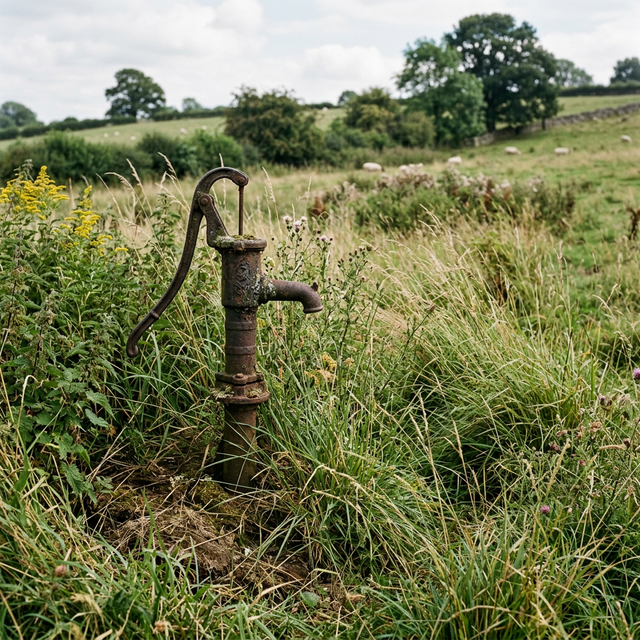
- Strange Concrete or Pipes: Look for random, small concrete slabs (often 3x3 feet) in the middle of a field, or a 6-inch steel casing pipe sticking a few inches out of the weeds. These are classic well casings.
- Historical Aerial Imagery: Use Google Earth Pro’s "Historical Imagery" slider. Going back to satellite or high-altitude flight photos from the 1980s or 1990s can often reveal the footprint of old outbuildings, access roads, or disturbed earth that have long since been obscured by forest growth, pointing you to old homestead sites.
2. Decommissioning an Abandoned Well
If you find a rusted pipe plunging hundreds of feet into the earth, you cannot simply throw a cinderblock over it or fill it with driveway gravel.
The Legal Framework
Nearly every state's Department of Environmental Protection (or equivalent) has strict laws classifying unsealed wells as a severe threat to public water tables. If a neighbor’s active well is contaminated by agricultural runoff pouring down an unsealed abandoned well on your property, you can be held legally and financially liable.
The Sealing Process
You must hire a licensed well driller to properly decommission (plug) the well.
- The driller will flush the casing to remove debris.
- They will pump a specialized bentonite clay slurry or neat cement directly from the bottom of the well all the way up to the top. This specialized material expands when wet, creating an impermeable, permanent seal against the bedrock, preventing surface water from traveling down into the aquifer.
- The driller will cut off the steel casing 3 to 4 feet below the surface, cap it, and cover it back over with topsoil so you can safely farm over it.
- Finally, they submit a legally binding "Well Abandonment Report" to the state on your behalf.
Expect to pay between $500 and $1,500 for a professional well plugging. Fortunately, many local Soil and Water Conservation Districts offer 50% cost-share grants to help landowners afford this critical environmental protection.
3. Addressing Collapsing Septic Systems
If the property previously held a mobile home or an old cabin that was torn down, the septic system was likely left completely intact underground. Over decades, the steel or pre-cast concrete lids of the tank severely degrade. The weight of an ATV, a horse, or even a person walking over it can cause a catastrophic collapse into a deep pit of toxic sludge.
How to Mitigate a "Zombie" Septic
If you discover an old septic tank, treat it as a critical safety hazard until mitigated. Do not attempt this as a DIY weekend project.
- Pumping: Hire a commercial septic pumper to completely empty the tank of any lingering toxic liquids or sludge.
- Crushing the Lid: For a complete decommission, the tank must be structurally neutralized. A heavy equipment operator (or the septic company itself) will use an excavator to physically crush the top lid and upper walls of the empty tank inward.
- Puncturing the Floor: Crucially, the excavator bucket must be used to violently punch holes through the solid concrete floor of the tank. If you skip this step, the buried, crushed tank will simply act as a bathtub, filling with rainwater and creating an eternal, rotting sinkhole on your land.
- Filling: Once the floor is shattered to allow drainage, the crushed void is completely backfilled with clean sand or gravel and compacted.
4. Summary and Next Steps
Abandoned wells and septic systems represent extreme liability—both environmentally and physically. When buying land, a surface inspection is not enough. You must actively hunt for historical homestead sites and budget for the professional mitigation of deep hazards.
Action Steps:
- Call your county health department before purchasing raw land to ask if they have any historical permits or records regarding septic installations on that parcel.
- Use historical satellite imagery to identify old structure footprints, and physically walk those areas looking for metal pipes or mysterious concrete slabs.
- Call your local Soil and Water Conservation District to ask if they offer financial grants for plugging abandoned agricultural wells.
To ensure your active water systems are safe and sustainable, review our guide on Capturing and Storing Rainwater Maternally.
Sources & Further Reading
- EPA (Environmental Protection Agency) - Plugging Abandoned Wells: epa.gov
- National Ground Water Association (NGWA) - Wellowner.org Resources: wellowner.org
- Penn State Extension - Safely Decommissioning Abandoned Wells: extension.psu.edu
- Purdue University Extension - Septic System Abandonment Guidelines: extension.purdue.edu
Written by Prof. James Chen, Contributing Expert - Water Resources at LandHelp.info. Professor Chen consults extensively on rural groundwater protection and mitigating agricultural aquifer contamination.
Tags:

Prof. James Chen
Contributing Expert - Water Resources
Professor Chen is a leading expert in watershed management and water conservation. With 25 years in academic research and extension, he has published extensively on sustainable water management practices for agricultural lands.