Creating Food Forests with Minimal Maintenance: Starter Plant Lists
Design a high-yield, low-maintenance food forest on your small acreage using permaculture layers and resilient plant guilds.
Creating Food Forests with Minimal Maintenance: Starter Plant Lists
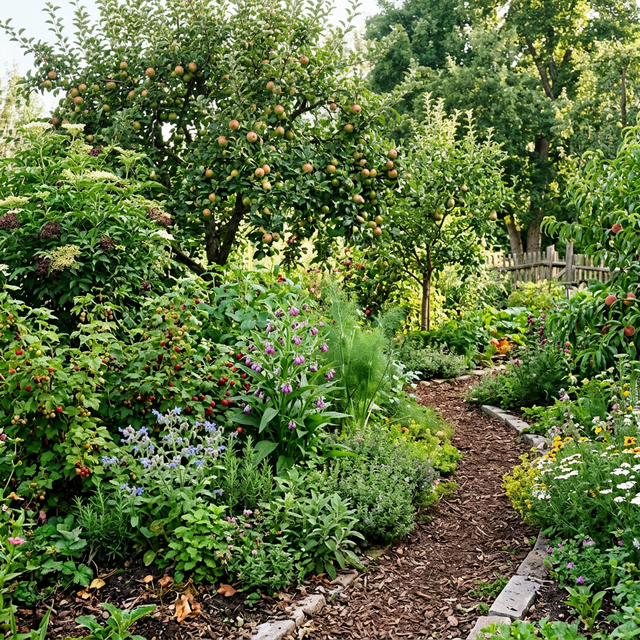
A traditional fruit orchard requires constant pruning, spraying, mowing, and fertilizing to produce a harvest. In contrast, a "food forest" (or forest garden) mimics the architecture and self-sustaining ecology of a natural woodland ecosystem, replacing traditional landscape plants with edible, medicinal, and ecologically useful species.
By designing your planting area in distinct vertical layers, you create a dense, perennial ecosystem that largely takes care of its own pest control, fertility, and weed suppression. While establishing a food forest takes significant effort in the first three years, the mature system requires a fraction of the maintenance of a traditional garden or orchard.
Why is this important for private landowners? Because creating a resilient, perennial food system provides long-term food security, improves soil health, and creates unparalleled wildlife habitat on properties as small as half an acre. In this guide, we break down the seven structural layers of a food forest and provide robust starter plant lists for a minimal-maintenance design.
1. The Anatomy of a Food Forest: The 7 Layers
A natural forest maximizes sunlight and root space by stacking plants vertically. A classic permaculture food forest utilizes seven distinct layers:
- Canopy (Overstory): Large, towering nut trees or full-size fruit trees that form the ceiling.
- Sub-Canopy (Understory): Dwarf and semi-dwarf fruit trees that thrive in the dappled edges.
- Shrub Layer: Bush fruits and berries.
- Herbaceous Layer: Non-woody perennials, culinary herbs, and flowers that die back to the ground in winter.
- Groundcover Layer: Creeping plants that act as living mulch to suppress weeds.
- Rhizosphere (Root Layer): Root crops like garlic, sunchokes, or true yams.
- Vertical (Climbing Layer): Vines that utilize the trees for physical support.
2. Building "Guilds" for Minimal Maintenance
You do not plant these layers randomly. Instead, you design guilds—intentional groupings of plants centered around a primary fruit or nut tree. The supporting plants in the guild perform specific "jobs" so you don't have to:
- Dynamic Accumulators: Deep-rooted plants (like comfrey) that pull minerals from deep subsoil and deposit them on the surface when their leaves die back.
- Nitrogen Fixers: Plants (like goumi or white clover) that pull atmospheric nitrogen into the soil, acting as permanent, living fertilizer.
- Pest Repellents: Aromatic herbs (like chives, mint, dill) that confuse pests and attract predatory wasps that eat aphids.
3. Minimal-Maintenance Starter Plant List (Temperate Climates)
If you live in USDA Hardiness Zones 4 through 7, a common mistake is planting high-maintenance species (like peaches or modern dessert apples) that require massive interventions to survive local disease pressures. Instead, focus on robust, historically resilient species.
The Canopy Layer (Choose 1 or 2 to anchor the guild)
These will grow large. Space them 30 to 50 feet apart.
- Chestnut (Blight-Resistant Hybrids): Reliable carbohydrate production.
- Pecan or Hickory: Slow-growing but incredibly resilient legacy trees.
- Black Walnut: Warning: Black walnuts secrete juglone, which kills many other plants (like apples and tomatoes). If you plant walnut, your guild must be composed entirely of juglone-tolerant species (like pawpaw, black raspberry, and elderberry).
The Sub-Canopy Layer (The primary fruit producers)
- Pawpaw (Asimina triloba): The largest native fruit in North America. Highly deer-resistant, shade-tolerant, and suffers from almost zero pests. (Requires two different varieties for pollination).
- Persimmon (American or Asian): Incredibly tough, drought-resistant, and visually stunning.
- Mulberry: Massive yields of berries; practically indestructible.
- Disease-Resistant Apples: If you must plant apples, choose immune varieties like Liberty, Enterprise, or GoldRush to avoid spraying for cedar apple rust or apple scab.
The Shrub Layer
- Elderberry (Sambucus canadensis): Native, fast-growing, excellent medicinal berries, and handles wet soils.
- Goumi (Elaeagnus multiflora): Produces tart red berries and is a powerful nitrogen-fixer, feeding the trees around it.
- Hazelnuts (Corylus): Shrubby nut producers that thrive on woodland edges.
- Currants and Gooseberries: Highly shade-tolerant, making them perfect for planting directly under the canopy trees.
The Herbaceous and Groundcover Layers
These suppress weeds and cycle nutrients.
- Comfrey (Bocking 14 strain): The ultimate dynamic accumulator. Cut the massive leaves three times a year and drop them around the base of your fruit trees as mulch.
- White Dutch Clover: A low-growing nitrogen fixer that creates a soft, walkable carpet and out-competes grass.
- Daffodils: Plant a tight ring of daffodil bulbs directly around the trunk of your young fruit trees. Toxins in the bulbs deter voles and mice from chewing the tree bark in winter.
- Mint/Lemon Balm: Excellent aromatic pest deterrents (but keep them contained or they will spread aggressively).
The Root and Vine Layers
- Sunchokes (Jerusalem Artichoke): Extremely productive, tall sunflower-like plants that yield edible tubers. (Harvest aggressively or they take over).
- Hardy Kiwi (Actinidia arguta): A vigorous vine that produces smooth, grape-sized kiwis. Must be grown on a very strong trellis or allowed to scramble up a mature (non-fruit) canopy tree.
4. The 3-Year Establishment Phase
A food forest is low maintenance at maturity, but the first three years dictate success or failure.
- Eradicate Grass: Turfgrass will choke out your newly planted food forest. Smother the area using "sheet mulching" (overlapping thick cardboard covered in 6 inches of woodchips) before planting.
- Protect from Browsing: Deer will decimate a young food forest. Every tree and shrub must be caged with woven wire fencing until the apical growing tips are above the browse line (roughly 5-6 feet high).
- Heavy Mulch and Water: Maintain a thick ring of woodchips around your guilds and water deeply once a week during dry spells for the first two summers.
Once the canopy closes and the groundcover establishes, the system will shade out weeds, retain its own moisture, and provide decades of foraging.
5. Summary and Next Steps
By designing your plantings in stacked, cooperative layers, you can build an ecological engine that produces immense amounts of food while supporting local wildlife and building rich topsoil. Stick to disease-resistant natives and resilient hybrids to keep your maintenance requirements near zero.
Action Steps:
- Identify a sunny, well-draining spot on your property starting as small as 20x20 feet.
- Source large quantities of free woodchips (often available through local tree service companies or via apps like ChipDrop) to begin sheet mulching the grass.
- Sketch out a central canopy tree, flanked by smaller fruit trees and a dense ring of shrubs and herbs.
For more strategies on growing perennial systems on small acreages, explore our guide to Agroforestry or learn how to incorporate animals into your orchards with Multi-Species Grazing.
Sources & Further Reading
- TFA (Trees for Agriculture) / USDA - Agroforestry and Forest Farming: nac.unl.edu
- Project Food Forest - Guild Design and Implementation: projectfoodforest.org
- Permaculture Research Institute - The 7 Layers of a Food Forest: permaculturenews.org
- University of Missouri Extension - Edible Landscaping and Permaculture: extension.missouri.edu
Written by Tom Miller, Sustainable Living Expert at LandHelp.info. Tom has established complex, off-grid permaculture systems on multiple properties and specializes in low-input food production for rural homesteads.
Tags:
Tom Miller
Sustainable Living Expert
You Might Also Like
Related Resources
External tools, guides, and references related to this topic
Silviculture Guide to Species
Detailed silvicultural guides for major North American tree species. Covers regeneration, growth, and management of various forest types.
Forest Carbon Credits 101
Comprehensive guide to forest carbon credit programs. Learn how to enroll your forest land, measure carbon sequestration, and sell carbon credits.
Agroforestry Practices
Technical guides for implementing agroforestry systems including alley cropping, silvopasture, windbreaks, and forest farming.
Tree Planting Calculator
Calculate spacing, number of trees needed, and costs for reforestation projects. Includes species-specific recommendations.