How to Protect Your Streams and Wetlands from Erosion
Practical strategies to stop stream bank erosion and protect wetlands on private land. Covers riparian buffers, bioengineering, and USDA NRCS programs that fund erosion control.
How to Protect Your Streams and Wetlands from Erosion
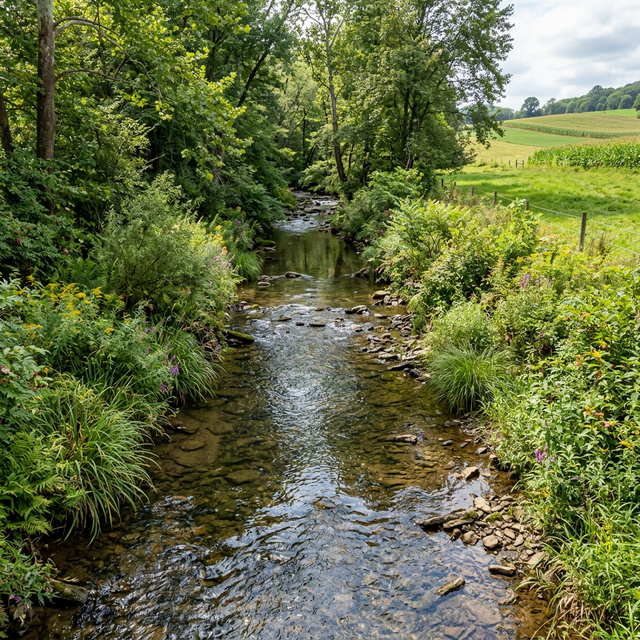
A creek that was stable for generations can start failing within a few seasons if the conditions around it change — livestock trampling the banks, upland fields tilled close to the edge, nearby development altering drainage patterns. Once a stream bank starts eroding, it's a self-reinforcing problem: the erosion undercuts roots, trees fall in, channelized flow accelerates, and the damage spreads upstream and downstream.
The good news is that landowners have a wide range of effective, proven tools to stabilize stream banks and protect wetlands — from simple vegetation strategies that cost almost nothing, to structural bioengineering approaches eligible for USDA cost-share funding.
This guide covers what causes erosion, what actually works to stop it, and how to access funding.
Understanding What Causes Stream Bank Erosion
Before choosing a solution, identify the cause:
| Cause | Signs | Priority Fix |
|---|---|---|
| Livestock direct access | Deep hoof prints, bare banks | Fencing + off-stream watering |
| Loss of riparian vegetation | No shrubs/trees within 10–30 ft of bank | Native plant establishment |
| Channelization/straightening | High-velocity straight channel | Grade control structures |
| Altered upland drainage | New ditches, impervious surfaces | Slow water with berms, wetlands |
| Flashy flows from upstream | Steep erosion after every rain | Grade control, check dams |
Getting the diagnosis right matters — installing expensive bioengineering structures won't help if livestock are still trampling the banks nightly.
Strategy 1: Riparian Buffers — Your First Line of Defense
A riparian buffer is a zone of native vegetation along a stream bank. It may be the single most cost-effective stream protection strategy available to private landowners.
How Riparian Buffers Work
- Root systems bind soil and resist erosion even during flood events
- Canopy shades the stream, reducing algae growth and moderating temperature (critical for trout)
- Leaf litter and woody debris create aquatic habitat
- Overhanging grass and sedges filter runoff before it enters the water
Riparian Buffer Width Guidelines
According to USDA NRCS Practice Standard 391, buffer width should be:
- Minimum 35 feet for basic water quality protection
- 50–100 feet for streams with active erosion or on steep slopes
- Variable width following natural topography for best results
What to Plant in a Riparian Buffer
Choose native species suited to your region. Common recommendations:
Grasses and sedges (nearest water): Switchgrass, big bluestem, river bulrush, woolgrass sedge
Shrubs (middle zone): Silky dogwood, button bush, elderberry, native willows
Trees (outer zone): Sycamore, cottonwood, river birch, silver maple, bald cypress (South)
Avoid invasive species like Chinese privet or Japanese knotweed, which are widespread along stream corridors and aggressively outcompete native riparian vegetation.
Strategy 2: Exclude Livestock from Streams
Livestock cause more stream bank degradation per acre than almost any other land use. Direct access allows:
- Physical erosion of banks under hooves
- Streamside vegetation destruction
- Nutrient (nitrogen, phosphorus, E. coli) loading directly into the water
Fencing livestock out of streams is often the highest-return conservation practice a livestock producer can implement.
How to Set Up a Livestock Exclusion System
- Install high-tensile fence at least 35 feet from the top of the stream bank on each side
- Provide alternative water sources — a solar-powered pump to a tank typically costs $1,500–$3,000
- Create a watering lane if needed (a stabilized narrow access point with a concrete apron)
- Allow vegetation to recover — within 2–3 seasons, banks will often stabilize naturally if grazing pressure is removed
USDA NRCS EQIP frequently funds livestock exclusion fencing and alternative watering at 50–75% cost-share. This is often one of the fastest EQIP practices to get funded.
Strategy 3: Bioengineering — Working With Nature to Stabilize Banks
Bioengineering uses live plant material — stakes, bundles, and root wads — to stabilize eroding banks. It's particularly effective for moderate erosion where the channel is otherwise functioning normally.
Common Bioengineering Techniques
Live Stakes: Willow or dogwood cuttings driven directly into eroding banks. Roots establish within one season, providing both structural and biological stabilization. Cost: Very low.
Brush Mattresses: Bundles of live branches layered along a bank and staked in place, then covered with soil. Excellent for large eroding slopes.
Root Wads: Large root masses from fallen trees placed at the toe (base) of an eroding bank. Mimics natural large woody debris; creates fish habitat while deflecting flow.
Log Vanes and Rock Cross-Vanes: Low-profile structures built from rock or logs that deflect current away from eroding banks and slow velocity. Require some engineering knowledge to install correctly.
Strategy 4: Protecting Wetlands
Wetlands are often the first thing to go on private land — they're seen as unproductive, mosquito-ridden, and hard to use. But wetlands provide enormous value:
- Flood storage: 1 acre of wetland can store 1–1.5 million gallons of floodwater
- Water quality: Remove 80% or more of nitrogen and phosphorus before water enters streams
- Wildlife habitat: Wetlands support more wildlife species per acre than almost any other habitat type
How to Protect an Existing Wetland
- Never fill or drain a wetland without checking federal and state permits — Section 404 of the Clean Water Act makes filling or draining most wetlands a federal violation
- Establish a 50–100 foot upland buffer of native vegetation around the wetland perimeter
- Exclude livestock using the same fencing approach as for streams
- Control invasive species like common reed (Phragmites) or purple loosestrife before they dominate
Restoring a Degraded Wetland
If your wetland has been drained by a tile drain or ditch, restoration is often possible. USDA NRCS offers the Wetland Reserve Easement (WRE) program, which pays landowners the agricultural value of wetland acres in exchange for a permanent easement — and then covers the cost of restoration work. It's one of the most generous conservation programs available.
USDA Programs That Fund Erosion Control
| Program | What It Funds | Typical Cost-Share |
|---|---|---|
| EQIP | Fencing, alternative watering, bioengineering, riparian buffers | 50–75% |
| CSP | Enhancements to existing conservation practices | Annual payments |
| RCPP | Regional partnerships, often includes water quality focus | Varies |
| WRE | Wetland easements + restoration funding | Up to 100% of restoration |
Contact your local NRCS office to find out which practices are funded in your state. Funding priorities vary significantly by region.
Summary
Stream and wetland protection is one of the highest-impact things a private landowner can do — for water quality, wildlife, and property value. Start with the simplest interventions: fence out livestock, establish a riparian buffer with native vegetation, and control invasive species. For active erosion, consult with your local NRCS office — cost-share funding through EQIP can make bioengineering and structural stabilization affordable.
Learn more: Visit our Water Resources section or explore water rights basics for private landowners.
Sources & Further Reading
- USDA NRCS — Riparian Buffers (Practice Standard 391): nrcs.usda.gov
- Penn State Extension — Stream Bank Erosion and Stabilization: extension.psu.edu
- National Resources Defense Council — Wetland Facts: nrdc.org
- US Army Corps of Engineers — Wetland Regulatory Program: usace.army.mil
- USDA NRCS — Wetland Reserve Easement: nrcs.usda.gov
- Virginia Cooperative Extension — Livestock and Water Quality: ext.vt.edu
- Stroud Water Research Center — Riparian Buffer Research: stroudcenter.org
Written by Prof. James Chen, Contributing Expert – Water Resources at LandHelp.info. Professor Chen holds a Ph.D. in Hydrology and has 25+ years of experience in watershed management and water conservation for agricultural lands.
Tags:

Prof. James Chen
Contributing Expert - Water Resources
Professor Chen is a leading expert in watershed management and water conservation. With 25 years in academic research and extension, he has published extensively on sustainable water management practices for agricultural lands.
You Might Also Like

Related Resources
External tools, guides, and references related to this topic
Pond Management Handbook
Comprehensive guide to pond construction, stocking, and management. Covers everything from site selection to fish stocking rates and water quality management.
NRCS Wetland Restoration
Technical guides and financial assistance programs for wetland restoration on private lands. Includes design specifications and plant selection guides.
Water Rights Database
Interactive database for researching water rights by state. Essential for understanding your legal water usage rights and restrictions.
Irrigation System Design Calculator
Free online calculator for designing efficient irrigation systems. Calculates flow rates, pressure requirements, and pipe sizing.