Creating a Pollinator & Beneficial Insect Refuge Strip Along Crop Fields
Increase crop yields and reduce pesticide use by planting a functional 'beetle bank' or pollinator refuge strip along the edges of your agricultural fields.
Creating a Pollinator & Beneficial Insect Refuge Strip Along Crop Fields
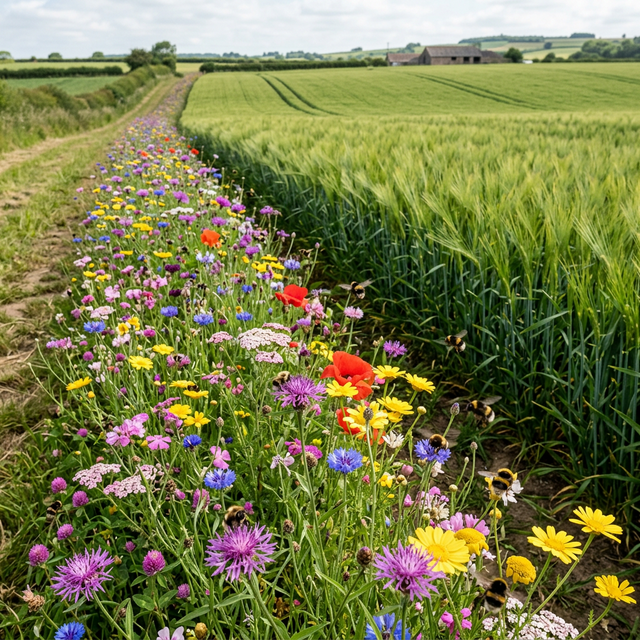
In modern, large-scale agriculture, the goal is often absolute efficiency: planting cash crops from fencerow to fencerow. However, this relentless monoculture creates a biological vacuum. When you eliminate all non-crop vegetation, you don't just kill the weeds; you evict the predatory insects that naturally control crop pests, and you starve the pollinators required for high crop yields.
In 2026, progressive farmers and small-acreage homesteaders are intentionally pulling land out of production to install Refuge Strips (also known as Beetle Banks or Pollinator Buffers).
By dedicating a mere 5% of your total field area to a permanent, unplowed strip of diverse native grasses and wildflowers, you can establish a localized standing army of predatory wasps, ground beetles, and native bees. This practice is the cornerstone of advanced Integrated Pest Management (IPM), drastically lowering insecticide costs while boosting pollination rates.
1. What is a Refuge Strip (Beetle Bank)?
A refuge strip is a linearly planted strip of permanent, perennial vegetation running either along the border of an agricultural field or directly through the middle of it.
The Mechanism of Action
In a traditional plowed field, ground-dwelling predatory insects (like Carabid beetles that eat massive amounts of slug eggs and aphid larvae) are killed or displaced every time a tractor tills the soil.
- By creating an unplowed, slightly raised berm planted with thick bunch-grasses, you provide a safe, dry, permanent overwintering site.
- In the spring, instead of waiting for predators to slowly migrate back into your field from the distant forest edge, an army of predatory beetles and wasps marches directly out of the refuge strip into the cash crop, obliterating pest outbreaks before they reach economic thresholds.
2. Designing the Perfect Strip
A successful refuge strip requires specific plant architecture. A strip of mowed turfgrass provides zero protection for insects.
The Foundation: Native Bunch Grasses
You must plant bunch grasses (like Little Bluestem, Big Bluestem, or Prairie Dropseed), not sod-forming grasses (like fescue or bluegrass).
- Bunch grasses grow in distinct, tight clumps, leaving small patches of bare dirt between them.
- Ground beetles and native solitary bees (which nest in the soil) require these tiny bare-dirt pathways to navigate and burrow. In a thick mat of sod, they simply cannot move.
The Fuel: Continuous Blooming Forbs
Predatory wasps (which paralyze caterpillars and aphids to feed their young) are tiny and have very short mouthparts. They cannot access deep, complex flowers. You must provide a continuous nectar source from spring to fall to fuel these predators.
- Spring Bloomers: Golden Alexander, Native Yarrow.
- Summer Bloomers: Common Boneset, Rattlesnake Master, Purple Coneflower.
- Fall Bloomers: Smooth Aster, Stiff Goldenrod.
Remember: Many adult predatory wasps survive entirely on nectar; they only kill pests to feed their larvae. If your farm lacks flowers, you have no predatory wasps.
3. Installation and Maintenance
You can establish a refuge strip using traditional farm equipment, eliminating the need for specialized manual labor.
The Installation Process
- Location: Select a long, straight edge of your field, or run a strip directly down the center of a massive field (most predatory beetles will only travel 100 to 150 feet out from the sanctuary of the strip). The strip should be 6 to 10 feet wide.
- Site Prep: You must eradicate all aggressive agricultural weeds (like Johnsongrass or Palmer Amaranth) in the strip zone before planting. This usually requires a full season of repeated tillage or herbicide application.
- Planting: Use a specialized native-seed drill (often available for rent from your local Soil and Water Conservation District) to plant the seed mix right before a rain or snow event in late fall or early spring.
Minimal Maintenance
Once established, a refuge strip is incredibly low-maintenance.
- You NEVER till it.
- You NEVER spray insecticide within 30 feet of it.
- You mow it only once every three to four years in the late winter (February) to prevent woody trees from taking over, ensuring you don't chop down standing flower stalks during the winter when native bees are hibernating inside the hollow stems.
4. Funding the Buffer
You do not have to pay for this out of pocket. The federal government recognizes the immense ecological and agricultural value of these strips.
- Through the USDA NRCS Conservation Stewardship Program (CSP) or EQIP (specifically Practice Code 327 - Conservation Cover or Practice 393 - Filter Strip), you can receive direct payments that often cover the complete cost of the premium native seed mix and the physical installation.
5. Summary and Next Steps
Sacrificing a tiny sliver of crop acreage to plant a permanent refuge strip is not a loss of production; it is an investment in biological insurance. By providing year-round shelter and nectar for predatory insects and pollinators, you build a resilient, self-regulating agricultural ecosystem that requires vastly less chemical intervention.
Action Steps:
- Identify a 10-foot wide strip along the edge of your most pest-prone crop field or large vegetable plot to dedicate as a permanent refuge.
- Contact a reputable native seed supplier (like Ernst Conservation Seeds or Prairie Moon Nursery) to source a specific "Pollinator & Beneficial Insect" seed mix tailored to your local soil type.
- Call your county NRCS agent to ask about cost-share funding for establishing agricultural filter strips.
To learn how to quickly access state-level funding to buy this exact seed, read our Quick Application Guide to State Grants.
Sources & Further Reading
- The Xerces Society - Farming with Native Beneficial Insects: xerces.org
- Penn State Extension - Beetle Banks for Beneficial Insects: extension.psu.edu
- SARE (Sustainable Agriculture Research & Education) - Managing Insects on Your Farm: sare.org
- USDA NRCS - Conservation Practice Standard 327 (Conservation Cover): nrcs.usda.gov
Written by Maria Rodriguez, Wildlife Biologist & Conservation Programs Advisor at LandHelp.info. Maria assists farmers in integrating robust biological pest control systems into large-scale conventional and organic agricultural operations.
Tags:

Maria Rodriguez
Wildlife Biologist & Conservation Programs Advisor
Maria specializes in wildlife habitat improvement and navigating conservation incentive programs. She has helped hundreds of landowners access NRCS programs and improve habitat on their properties.